
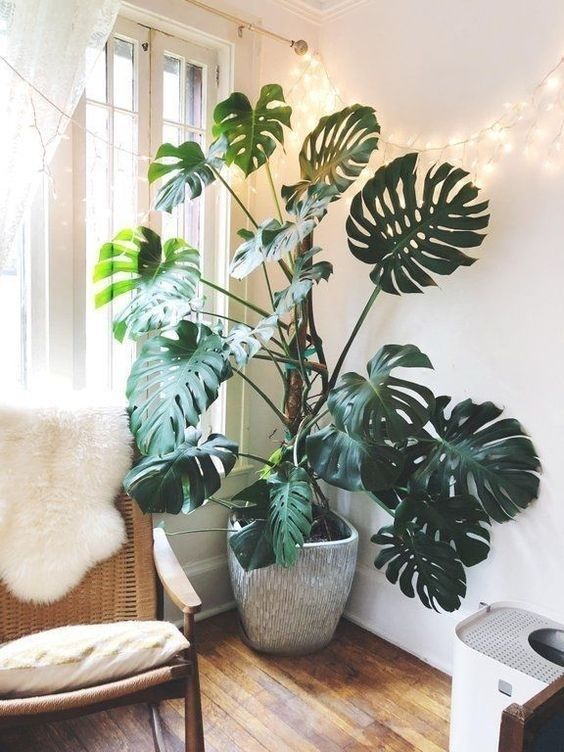
How to Style a Giant Monstera in an Open-Plan Living Room Without It Taking Over
Embracing the Wild Beauty of a Massive Monstera
An overgrown Monstera deliciosa can create two very different feelings. First comes the excitement of watching enormous, split leaves unfurl across the room. Then comes the sudden panic when those same leaves begin reaching toward the sofa, the dining table, and every clear path through the apartment. The good news is that a giant Monstera does not need to be reduced to a small, tightly clipped plant to look polished. With the right support and a little spatial planning, its wildness can become the most attractive feature in the room.
Open-plan homes are especially well suited to grand architectural plants because they offer the visual breathing room that large foliage needs. A tall Monstera can define the transition between a lounge and dining area, soften hard architectural lines, and add height where furniture usually remains low. The challenge is maintaining the fine line between a striking focal point and leafy clutter. Thoughtful training, clear walkways, warm lighting, and tactile materials such as linen, oak, jute, and terracotta can turn an unruly plant into a calm botanical anchor. For more inspiration on indoor plant design and natural materials, explore this biophilic interiors resource.
Understanding the Natural Growth Habit of Monstera Deliciosa
A Monstera is not naturally a neat, rounded bush. It is an energetic tropical climber with a growth habit shaped by forests, where stems search for trunks, branches, and patches of brighter light. In the home, that instinct remains. A mature plant may produce long stems, broad petioles, large leaves, and aerial roots that reach outward in several directions. Once this structure is understood, the plant becomes much easier to style because every apparently awkward feature has a purpose. For a concise botanical reference, consult the Authoritative Source when assessing the plant”s climbing form and mature growth.
Aerial roots can appear to wander across hardwood floors, pot rims, and rug surfaces. They are looking for support and moisture, rather than deliberately making a mess. Avoid forcing them flat against the floor or cutting them simply because they look unusual. Where practical, guide them gently toward the soil or wrap them around a support. Aerial roots can also help a climbing plant attach itself and develop stronger upright growth, although they should never be bent sharply or pulled away from the stem.
The leaves provide another useful clue to future space requirements. Fenestrations, the natural splits and holes in mature leaves, allow the plant to manage its large canopy while reducing some wind resistance in its native environment. A plant with increasingly large, fenestrated leaves is likely entering a more substantial growth phase, so it needs both vertical support and enough clearance around the foliage. The National Parks Flora and Fauna Web profile offers useful botanical background for understanding the species and anticipating its vigorous climbing habit.
- Look at the main stem to identify the direction of established growth.
- Allow space for leaves to extend outward without blocking doors or walkways.
- Expect mature foliage to become wider and heavier as the plant develops.
- Treat aerial roots as part of the plant”s structure, not as unwanted decoration.
Architectural Vertical Training with Moss Poles and Sturdy Stakes
Vertical training is the quickest way to transform a sprawling Monstera into a deliberate living column. A thick moss pole, coco coir pole, or suitably sturdy plant stake gives the stems a destination. Instead of allowing every vine to travel horizontally across furniture, guide the plant upward so its foliage forms a layered, sculptural silhouette. This also makes the plant easier to position beside a sofa, behind a lounge chair, or at the edge of a dining zone.

Work slowly with an established plant. Mature stems can be surprisingly stiff, and forcing them into a sharp new angle may cause cracks or damage around the nodes. The support should be installed securely in the pot, ideally before the plant becomes too top-heavy. If the current pot is already crowded with roots, avoid pushing a stake through the centre of the root ball. Position the support close to the rear of the main stem and use a heavier outer pot or a stable base to reduce the risk of tipping.
For proper developmental guidance and horticultural context on tropical climbing vines, consult the University of Florida extension guide. The main principle is simple: the support should follow the plant”s natural climbing side, while ties should hold the stem gently rather than compressing it.
- Choose a pole that is tall and thick enough to support the plant”s current height, with some room for future growth.
- Place it behind the main climbing stem, taking care not to pierce thick roots or force the stake through a dense root mass.
- Secure the lowest section first using soft jute twine, fabric ties, or plant velcro.
- Attach the stem at several points, preferably behind petiole junctions where the ties are less visible.
- Guide aerial roots downward toward the soil or gently around the pole.
- Check the ties every few weeks and loosen them as the stem thickens.
Plant velcro is especially convenient because it can be adjusted without cutting into the stem. Jute twine offers a softer, more natural appearance, but it should never be tied tightly. Keep the ties supportive rather than restrictive. The goal is not to flatten every leaf into a rigid wall. A small amount of irregularity preserves the plant”s natural character while giving the overall form a clear vertical rhythm.
Textural Pairings That Soften Leafy Volume
Large Monstera leaves are glossy, saturated, and visually powerful. Pairing them with more matte, tactile materials prevents the room from feeling overly shiny or visually busy. Slubby raw linen curtains are an excellent choice because their uneven weave introduces softness without competing with the leaf shapes. A chunky woven jute rug can provide a broad, quiet foundation, especially when the plant sits near the boundary between lounge and dining areas.
Warm timber also helps ground a tall plant. Oak shelving, a reclaimed wood console, or a low timber coffee table can echo the organic lines of the stem and aerial roots. Unglazed terracotta works particularly well for pots because its earthy surface balances deep green foliage and gives the container a crafted, grounded quality. For a more restrained scheme, choose one dominant natural material and repeat it in two or three smaller details rather than filling the room with competing textures.
| Material | Best visual contribution | Practical styling idea |
|---|---|---|
| Raw linen | Softness and filtered light | Use for curtains or relaxed cushion covers |
| Jute | Warm, tactile grounding | Place a large rug beneath the lounge arrangement |
| Warm oak | Natural structure and stability | Pair with a console, bench, or side table |
| Reclaimed timber | Texture and relaxed character | Use for shelving or a low media unit |
| Unglazed terracotta | Earthy colour and matte contrast | Choose a substantial outer planter |
Fabric can contribute more than colour alone. Texture changes how a room feels to the touch, while weave density affects light and sound. Softer, denser fabrics may also help absorb some reflected noise in open layouts. A useful biophilic fabric guide explains how tactile qualities, light interaction, acoustic behaviour, and fibre composition can support a nature-inspired interior. These materials do not replace daylight or living greenery, but they make the surrounding space feel more settled and comfortable.
Strategic Zoning and Lighting in Shared Open Layouts
A giant Monstera can act as an organic room divider without the heaviness of a bookcase or partition wall. Place it between a dining table and a lounge corner, or beside the end of a sofa where the canopy can define the seating area. The best position usually gives the plant a clear backdrop and enough surrounding air that its leaves remain legible. Avoid squeezing it into a narrow passage simply because an empty corner is available.
Walk around the room from every major entrance and check the plant at eye level. Leaves should not brush shoulders, obstruct a cupboard, or force people to turn sideways. If the canopy is too wide, prune a damaged or badly positioned leaf, retrain one stem, or rotate the pot gradually so the plant grows toward a better light source. Small adjustments are more effective than waiting until the plant has completely taken over.
- Keep the main walking route clear, especially between the kitchen, dining area, and front door.
- Position the largest leaves toward open space rather than directly into seating areas.
- Use a stable saucer or watertight tray to protect flooring beneath the pot.
- Turn the plant occasionally if growth becomes strongly one-sided.
- Use warm supplemental lighting when natural light is weak, while keeping the fixture safely away from wet leaves and fabric.
Monstera generally benefits from bright, indirect light, but harsh direct sun through glass can scorch large leaves. In a darker apartment, a warm-spectrum grow bulb in a floor lamp or pendant can support growth while contributing to the room”s atmosphere. A grow light should be selected according to the fixture, distance, and plant needs, then run on a consistent schedule rather than left on continuously. Keep supplemental lighting comfortably below the plant”s maximum recommended exposure and follow the manufacturer”s instructions.
Create Your Own Effortless Living Sanctuary
A gigantic Monstera looks most successful when it feels like an intentional botanical sculpture rather than an untamed jungle. The aim is not perfect symmetry. It is a clear relationship between the plant”s natural form and the room around it. A sturdy vertical support gives the stems direction, while linen, jute, timber, and terracotta provide the quieter textures needed to balance the scale of the foliage.
Give yourself permission to adjust the arrangement as the plant changes. Prune a damaged leaf, loosen a tie, add a taller support, or move a chair a few inches to restore breathing room. Then step back and view the entire open-plan space instead of focusing only on the pot. With a little seasonal attention, the Monstera can remain generous, lively, and beautifully wild while the room still feels calm, practical, and easy to live in.